
Elli Kypriadis on designing a world that feels lived-in – Film Daily
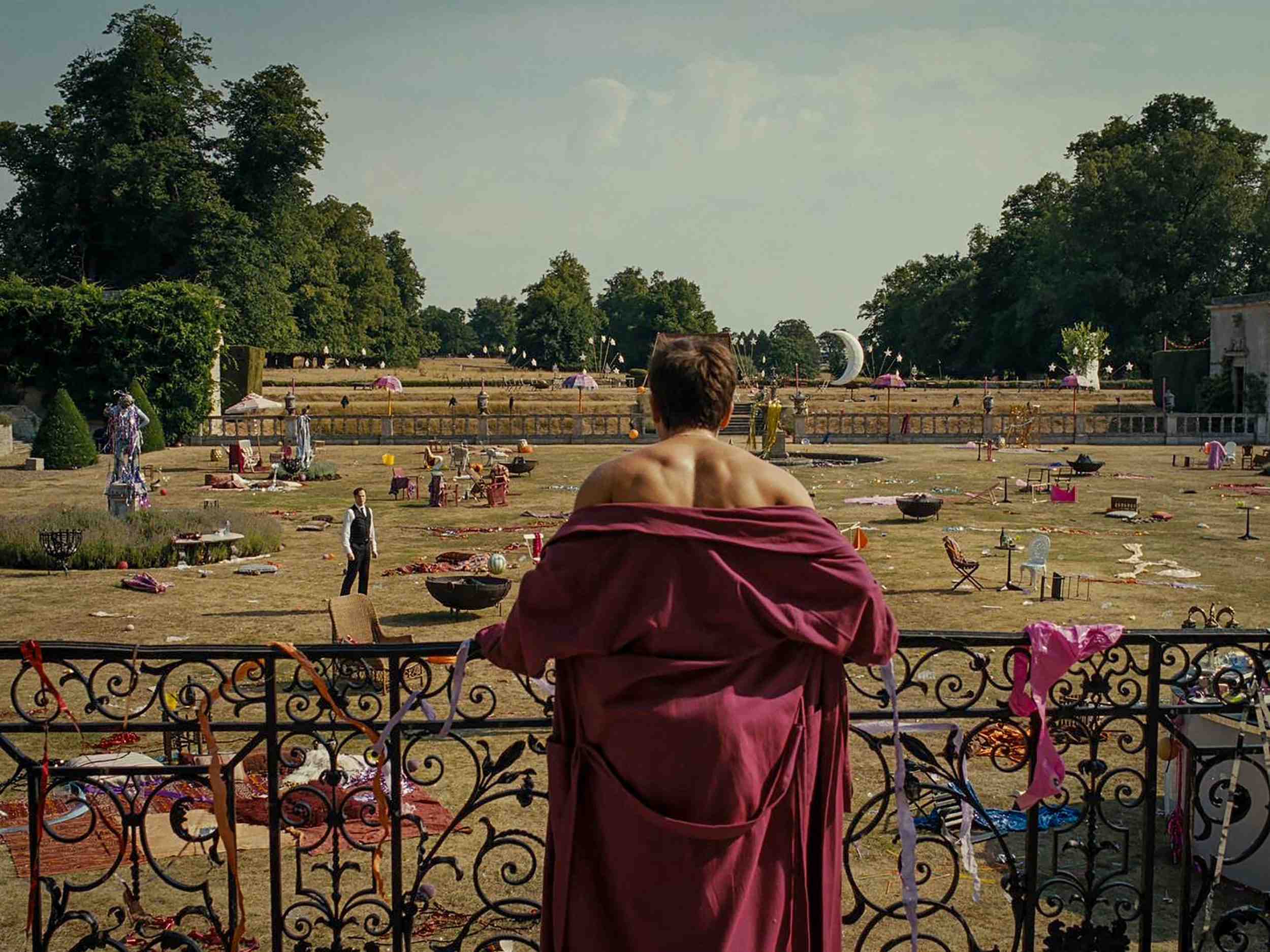
In Song of Silence, the world arrives before the story does. It presses in quietly—on the characters, on the frame, on the audience—until it becomes impossible to separate what is seen from what is felt. That pressure is by design. For Production Designer Elli Kypriadis, space is not a backdrop. It is an active force, one that shapes behavior, carries memory, and quietly dictates the emotional terms of a scene.

The film, set in a post-war 2071 America, imagines a matriarchal, mute society emerging from the ruins of a world destroyed by patriarchal extremism. It’s a concept that could easily lean into familiar science fiction tropes—clean lines, sleek materials, technological spectacle. Kypriadis rejects all of that outright. Instead, she builds a future defined by absence: no innovation, no new materials, no visual comfort. Everything is worn, reused, and slightly wrong.
“Every object needs a history and every surface should carry the sense that it has lived a life.”
Space as active narrative force
That philosophy sits at the center of her practice. Kypriadis doesn’t design for visual impact alone; she designs for continuity of existence. Her spaces feel as though they have been inhabited long before the camera arrived and will continue to exist after it leaves. The work is less about construction and more about archaeology—uncovering the traces of lives already lived.

That instinct began early. Growing up in the UK in a household surrounded by design, Kypriadis was immersed in the visual language of space from childhood. Books on architecture and interiors weren’t just reference points; they were frameworks for understanding how environments communicate.
“I was surrounded by the visual grammar of built environments,” she explains. “It gave me an early instinct for the way spaces can carry meaning or emotion.”
Early immersion shapes visual grammar
That instinct deepened through exposure to live performance. The Edinburgh Fringe, in particular, offered a formative lesson: that space is never neutral. A performance in a traditional theatre behaves differently than one staged under a bridge or in a car park. The architecture shapes the experience as much as the script.
“I was fascinated by the relationship between the performance and the space containing it.”
That fascination led her toward theatre studies at the University of Bristol, though even there, her focus drifted away from performance itself and toward the environments surrounding it. The questions she kept returning to were consistent: how does space influence behavior? What does an environment demand of the body moving through it?
Performance teaches space never neutral
At the time, she didn’t have the formal language for those questions. That came later, through film.
Designing her first film reframed everything. Theatre had taught her to build spaces for live performance, but film introduced a second layer—the image. The physical environment would be translated, flattened, and preserved in a two-dimensional frame.
“I found myself designing for two realities at once—the physical world the actor would move through and the image that would outlast it.”
Film adds a second reality
That tension remains central to her work. A space must function practically for actors and crew, but it must also resolve compositionally on camera. Texture, color, scale, and light all behave differently once mediated through the lens. Designing effectively means understanding both realities simultaneously.
Seeking to formalize that understanding, Kypriadis trained at the AFI Conservatory in Los Angeles, where she developed the technical discipline to match her instincts. AFI provided not just craft training, but a vocabulary—tools to articulate and execute ideas with precision.
From there, her career expanded quickly across both narrative and commercial work. She built environments for film and television projects, collaborated with internationally recognized actors, and contributed to large-scale campaigns for global brands including Marvel, Amazon, Bentley Motors, and Rakuten.
Balancing practicality and composition
Despite the range, the methodology remains consistent.
“Extraordinary production design should not be the exclusive property of the largest budgets.”
That statement is less a philosophy than a working principle. Kypriadis applies the same rigor to independent films and commercial projects that would typically be reserved for high-budget studio productions. It’s a deliberate leveling of standards—bringing cinematic world-building into spaces that are often treated as secondary.
Methodology transcends budget limits
Her commercial work reflects that approach. Campaigns reaching hundreds of millions of viewers are built with the same attention to detail as narrative films. One project alone generated nearly a billion impressions across platforms including CTV, TikTok, YouTube, and Google TV.
But it is in films like Song of Silence where her approach becomes most visible.
From the outset, the creative team made a critical decision: avoid recognizable sci-fi language. No polished surfaces. No clean futurism. Instead, they focused on defining the internal rules of the world before building anything physical.
Commercial work mirrors cinematic rigor
“Before touching anything physical we started by building out the rules of the world.”
In this version of 2071, war has halted progress. There are no new materials. The community inhabits an abandoned factory filled with objects that predate the collapse. Everything must feel as though it has been repurposed beyond recognition.
“Everything had to feel used and reused beyond recognition… genuinely strange rather than recognisable.”
World rules precede physical build
This is where Kypriadis’ process becomes highly system-driven. Every object introduced into the frame must comply with the logic of the world. There is no room for aesthetic shortcuts. If something doesn’t belong, the audience will feel it—even if they can’t articulate why.
“Everything either belongs or it doesn’t, and the audience will feel that.”
The production itself imposed significant constraints. Interiors were shot in a single empty location, requiring complete environmental transformation. Exteriors were staged in an abandoned power plant, which had to be dressed to reflect decades of habitation by a cohesive community.
System‑driven object logic
Constraint, for Kypriadis, is not a limitation. It is a filter.
“Constraint doesn’t limit authenticity so much as demand it.”
Without the resources to build everything from scratch, the work shifts toward recognition rather than fabrication. The designer must understand the world deeply enough to identify elements that already exist within it.
Constraint becomes creative filter
This approach draws on a broader network of collaboration. Los Angeles, she notes, is filled with individuals who have spent decades collecting objects—prop houses, craftspeople, and private collectors who maintain highly specific inventories. Accessing those resources requires both knowledge and trust.
One example illustrates the point. For a previous project set in a 1997 darkroom, Kypriadis sourced a fully functional darkroom from a war photojournalist via Facebook. The space was real, used, and layered with history.
“What we got by borrowing the real thing was something harder to manufacture… the sense that the room had actually been used.”
Network fuels authentic sourcing
That same sensitivity to authenticity informs Song of Silence. The goal is not to simulate reality, but to capture its residue—the marks left behind by use, time, and necessity.
Within that framework, individual design choices take on disproportionate importance.
The bathroom scene stands out as a defining moment. The narrative required a barrier—something that would obscure visibility while maintaining visual tension. A conventional shower curtain was tested and rejected. It felt too clean, too contemporary.
Bathroom scene demands uncanny solution
The solution came from an unexpected place: butcher’s curtains.
“They were uncanny in exactly the right way.”
The thick plastic strips, commonly used in industrial environments, aligned perfectly with the world’s logic. They obscured the subject just enough to shift focus while reinforcing the environment’s material language.
Butcher’s curtains fit the logic
“That felt like the whole film in one object.”
This is the level at which Kypriadis operates. Not broad gestures, but precise interventions—objects that encapsulate the logic of the entire world.
Her approach to space extends beyond physical construction into narrative function. She treats each environment as a character with its own psychology and history.
Objects become story characters
“A room that has truly been lived in can tell you who that person is without a single line of dialogue.”
This idea reframes production design as storytelling. The set is not merely a container for action; it is a source of information. Objects, textures, and spatial relationships communicate backstory, emotional state, and social structure.
In Song of Silence, this is particularly critical. The community is mute. Dialogue is minimal. The environment must carry narrative weight.
Room tells tale without dialogue
Every decision—from the arrangement of objects to the condition of surfaces—contributes to that communication. The audience reads the world intuitively, assembling meaning from visual cues.
Kypriadis’ process involves designing not just the present state of the space, but its past.
“I’m always designing the period before the film begins.”
Designing history before filming
What meals were eaten here? What conflicts occurred? What objects were repaired instead of replaced? These questions inform the design at every level. By the time filming begins, the space has a history.
That history is what actors interact with. It shapes performance in subtle but significant ways. A room with visible wear invites different behavior than a pristine set. The actor responds to the environment as much as the script.
This interplay between space and performance is one of Kypriadis’ core interests. It traces back to her early observations in theatre and continues through her film work.
Space exerts quiet pressure
“A space should exert pressure on the character, on the scene, on the viewer.”
That pressure is rarely overt. When the design is working effectively, it recedes into the background. The audience doesn’t consciously register the environment; they feel its influence.
“When the production design is really working you can’t tell where one ends and the other begins.”
Invisible design is disciplined planning
This invisibility is often misunderstood as simplicity. In reality, it is the result of extensive planning, iteration, and discipline. Every element must align with the world’s logic, the director’s vision, and the cinematographer’s frame.
Collaboration is central to this process. Production design sits at the intersection of multiple departments—direction, cinematography, costume, lighting. Each decision impacts the others.
Kypriadis works closely with directors to establish a shared visual language early in the process. This involves defining not just aesthetic choices, but underlying principles—what belongs in the world, what doesn’t, and why.
Collaboration defines shared visual language
That alignment allows for consistency across the production. It ensures that every department is working toward the same conceptual framework.
In Song of Silence, that framework extends to performance. The film features an all-deaf female cast, which introduces additional layers of consideration. Communication, movement, and spatial relationships operate differently. The environment must support those dynamics.
The result is a film where design, performance, and narrative are tightly integrated. Each element reinforces the others.
Framework supports deaf cast dynamics
Kypriadis’ work on the project has been recognized across major festival circuits, including Fantasia International Film Festival, SLASH Film Festival Vienna, and Dances With Films New York. The film also received a College Television Award nomination from the Television Academy Foundation.
These recognitions are significant, not just for the film, but for the role of production design within it. They highlight the impact of world-building on a film’s reception and success.
Kypriadis sees this as part of a broader trajectory. Her goal is to transition into feature-length narrative work, applying the same methodologies at a larger scale.
Recognition validates world‑building impact
“I am focused on transitioning… into feature-length narrative productions.”
That shift will bring new challenges—larger budgets, more complex logistics, broader distribution—but the core approach will remain unchanged.
The emphasis will still be on building worlds that feel real, that carry history, and that exert quiet pressure on the audience.
Transitioning to feature narratives
If anything, the increased scale will amplify those principles. Larger productions offer more resources, but they also introduce more variables. Maintaining coherence becomes more difficult—and more critical.
Kypriadis’ background across both the UK and US industries positions her well for this transition. Her work spans multiple production systems, cultural contexts, and distribution models.
“My background bridges the British and American industries.”
Scale amplifies core principles
This international perspective informs her approach to storytelling. It allows her to navigate different aesthetic traditions and production practices, adapting her methods as needed.
At the same time, it reinforces the universality of her core ideas. Regardless of location or budget, the fundamentals remain consistent: space shapes experience, objects carry meaning, and authenticity emerges from coherence.
In an industry often driven by spectacle, Kypriadis’ work offers a different model. It prioritizes depth over surface, logic over trend, and presence over display.
International bridge enriches storytelling
The worlds she builds are not designed to impress. They are designed to hold.
And in Song of Silence, that restraint becomes its own form of impact.

Related posts






Latest Post









No Comments