

Over the last century, documentaries have evolved from recorded observations into some of cinema’s most daring, emotionally devastating, and artistically ambitious works. The genre has exposed corruption, chronicled human triumph, and captured the raw beauty and brutality of the world in ways fiction cannot. From intimate character studies to globe-spanning visual symphonies, the best documentaries are true works of art.

Ranking the greatest documentary masterpieces of the last 100 years means weighing cultural impact, artistic innovation, and emotional resonance. The films selected here defined their eras; they changed conversations, influenced policy, and expanded what nonfiction storytelling could achieve. These are documentaries that linger long after the credits roll, reshaping how we see the world and the people within it.

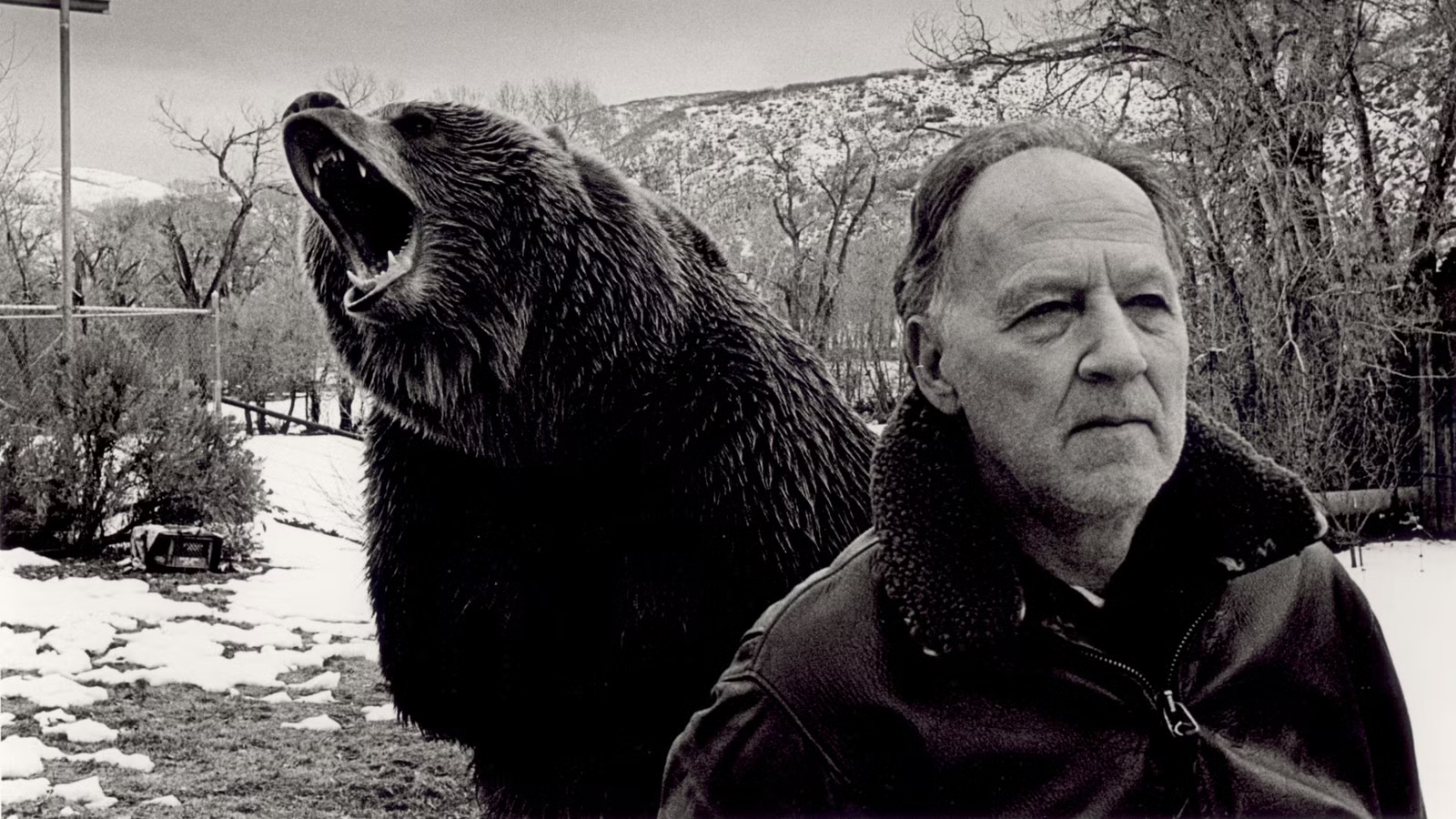
Few documentaries blur the line between obsession and tragedy as hauntingly as Grizzly Man. Directed by Werner Herzog, the film assembles footage shot by environmentalist Timothy Treadwell. Treadwell had lived among Alaskan grizzly bears for 13 summers before being brutally killed by one.
Rather than romanticize Treadwell’s mission, Herzog presents a complex portrait of a man driven by passion, delusion, and a desperate desire for connection. Grizzly Man is particularly extraordinary for refusing to simplify its subject. Herzog’s meditative narration wrestles with humanity’s relationship to nature
Herzog rejects the idea of wilderness as inherently harmonious. The result is a chilling yet compassionate exploration of hubris, loneliness, and the indifference of the natural world. It’s not merely a wildlife documentary, Grizzly Man is a philosophical reckoning with mortality itself.

Few documentaries have had such immediate real-world consequences as Blackfish. Directed by Gabriela Cowperthwaite, the film investigates the captivity of orca whales. It specifically centers on Tilikum, a SeaWorld whale involved in multiple deaths.
Through archival footage and interviews with former trainers, Blackfish dismantles the corporate narrative that these animals thrive in confinement. The film’s power lies in its structure. It builds tension like a true-crime documentary while grounding every revelation in heartbreaking testimony.
Rather than relying on overt sentimentality, Blackfish lets facts and firsthand accounts speak for themselves. The cultural fallout from Blackfish was swift: declining ticket sales, canceled performances, and renewed scrutiny of marine parks. Beyond its activism, the documentary stands as a masterclass in investigative storytelling. It’s gripping, focused, and impossible to ignore.

At nearly three hours long, Hoop Dreams redefined what a sports documentary could be. Directed by Steve James, the film follows Chicago teenagers William Gates and Arthur Agee over five years as they pursue NBA aspirations. What begins as a basketball story evolves into a sweeping examination of race, class, education, and systemic inequality in America.
The documentary’s brilliance comes from its patience. By embedding with its subjects for years, it captures triumphs and setbacks with remarkable intimacy. The camera observes rather than manipulates, allowing life to unfold in all its unpredictability.
When dreams falter, the emotional impact is devastating because the audience has lived alongside these young men. As a result, Hoop Dreams elevated sports storytelling. It demonstrated that documentaries could rival epic fiction in scope and emotional depth.

Directed by Ron Fricke, Samsara is a documentary without dialogue, interviews, or narration – and yet it speaks volumes. Filmed across 25 countries over five years, the movie is a visually staggering meditation on life, death, spirituality, and humanity’s relationship with the Earth. Shot on 70mm film, every frame feels meticulously composed, transforming real-world imagery into cinematic art.
What makes Samsara extraordinary is its experiential storytelling. The film juxtaposes sacred rituals with industrial machinery, natural wonders with overcrowded megacities. Without offering explicit commentary, it invites viewers to interpret its themes through pure observation.
The absence of words becomes its greatest strength. It encourages reflection rather than persuasion. In an era dominated by fast edits and heavy narration, Samsara stands as a reminder that documentary filmmaking can be as poetic and transcendent as any scripted epic.

The Cove is part eco-thriller, part investigative exposé. It masterfully plays with the tension of a Hollywood heist film while uncovering a horrifying truth. Directed by Louie Psihoyos, the documentary follows activist Ric O’Barry and a covert team as they infiltrate a restricted cove in Taiji, Japan, where dolphins are slaughtered in secret.
Hidden cameras, night-vision footage, and real danger elevate the film’s urgency. Yet what separates The Cove from other environmental documentaries is its structure. It transforms activism into cinematic suspense without sacrificing moral clarity.
The footage captured is deeply disturbing, but grounded in the mission of accountability and reform. The Cove’s Academy Award win cemented its legacy, but its real achievement lies in sparking global awareness and direct action. Few documentaries blend adrenaline and advocacy so effectively.

A predecessor to Samsara, Baraka is another breathtaking non-narrative experience from the same team. Directed again by Ron Fricke, this film spans six continents, capturing more rituals, landscapes, urban chaos, and sacred spaces without a single spoken word. Shot in 70mm, its imagery is immersive and absolutely stunning.
Like Samsara, it encourages audiences to contemplate humanity’s place within the larger tapestry of existence. Again, unlike traditional documentaries, Baraka offers no interviews or explanatory context. Instead, it communicates through juxtaposition – serene temples against factory farms, untouched wilderness against mechanized industry.
The result is both beautiful and unsettling. It invites interpretation rather than dictating conclusions, trusting viewers to draw their own emotional and philosophical connections. More than three decades later, Baraka remains a benchmark for purely visual storytelling in nonfiction cinema.

Few documentaries devastate audiences as completely as Dear Zachary. Directed by Kurt Kuenne, the film begins as a tribute to Andrew Bagby, who was murdered by his ex-girlfriend. Kuenne assembles interviews with friends and family as a keepsake for Bagby’s unborn son, Zachary.
What unfolds, however, becomes something far more tragic and infuriating. The documentary’s emotional power comes from its raw sincerity. Kuenne does not hide his grief or anger, and that vulnerability permeates every frame.
As shocking developments emerge, Dear Zachery transforms into an indictment of systemic failure within the justice system. It’s deeply personal yet universally resonant, leaving viewers shaken and heartbroken. Dear Zachary achieves an emotional intensity that rivals (and often surpasses) fictional tragedy.

Directed by James Marsh, Man on Wire chronicles one of the most audacious acts in modern history. It depicts Philippe Petit’s 1974 tightrope walk between the Twin Towers of New York’s World Trade Center. Framed like a caper film, the documentary reconstructs the meticulous planning and daring execution of the illegal stunt.
Man on Wire is particularly notable for its tone. Rather than focusing on danger alone, it captures the poetry and madness of artistic obsession. Archival footage and animated reenactments build tension even though the outcome is widely known.
The final high-wire sequence is breathtaking. Vitally, it managed to evoke wonder rather than fear. Beyond spectacle, Man on Wire is a meditation on risk, ambition, and the fleeting beauty of impossible dreams realized against all odds.

At over nine hours long, Shoah is less a film and more a monumental act of remembrance. Directed by Claude Lanzmann, the documentary confronts the Holocaust through interviews with survivors, witnesses, and even perpetrators. Crucially, it avoids archival footage, forcing audiences to confront testimony in the present tense.
This decision gives Shoah unparalleled immediacy. The absence of historical images prevents emotional distancing, making each recollection devastatingly personal. Lanzmann’s patient, unflinching approach refuses simplification or sensationalism.
Watching Shoah requires endurance, but that duration mirrors the weight of its subject. It stands as one of cinema’s most important historical documents – a moral reckoning preserved on film. Few documentaries demand as much from viewers, and fewer still reward that commitment with such profound impact.

Dziga Vertov’s Man with a Movie Camera remains the most revolutionary documentary ever made. A silent-era Soviet experiment, the film captures urban life across multiple cities in the Soviet Union while simultaneously revealing the filmmaking process itself. There is no narrative in the traditional sense, only movement, rhythm, and the mechanics of modern existence.
Vertov’s radical techniques were decades ahead of their time. He deploys split screens, double exposures, slow motion, and rapid montage. This excessive stylization is designed to interrogate how reality is constructed through cinema.
Man with a Movie Camera transforms everyday scenes into something electrifying. Nearly a century later, its influence is visible in music videos, experimental films, and modern nonfiction storytelling. Man with a Movie Camera stands as the greatest documentary masterpiece, forever changing what truth on film truly means.

September 16, 2011
102 minutes
Ron Fricke
Mark Magidson

Ni Made Megahadi Pratiwi
Dancer: Valinese Tari Legong Dancers, Indonesia
Puti Sri Candra Dewi
Tattoo Daddy: USA
Putu Dinda Pratika
Professor and Robot Clone: Japan
Marcos Luna
Man At Desk: France



September 15, 1992
97 minutes
Ron Fricke
Constantine Nicholas
Alton Walpole
Patrick Disanto
Journeyman (uncredited)

July 25, 2008
94 minutes
James Marsh
Philippe Petit
Jean François Heckel
Herself

May 12, 1929
68 Minutes
Mikhail Kaufman
The Cameraman
Elizaveta Svilova
Woman editing film

















The Social Dilemma & 9 Other Shocking Documentaries From The 2010s You Need To Watch
Those looking for some enlightening takes on subjects like social media and politics can head to this list of shocking documentaries from the 2010s.